
SMSF education course for professionals
Take your working knowledge of superannuation and SMSFs to the next level, one in-depth topic at a time.


Why choose
Super Extension course?
Our Super Extension course has been created to steadily increase your knowledge in the key areas of superannuation and SMSFs, enabling you to improve throughout your learning journey and eventually specialise in SMSFs.
01
Earn valuable CPD hours
Go deeper into a variety of essential topics, with the flexibility of studying one at a time. Super Extension explores 7 topics comprising 6-7 comprehensive modules each.
02
Practical takeaways
Pick up practical skills through the analysis of real-world client scenarios. Whatever your situation, Super Extension shows you how to apply the theory to the day-to-day.
03
Close essential gaps
The superannuation system can be complex and is subject to change. Super Extension helps you to confidently upskill and quickly close knowledge gaps.
Who is
Super Extension for?
This course builds on the fundamentals, and is perfect for anyone with superannuation and SMSF experience or those who have completed the Super Foundations course.
Accountants who work in SMSF accounting or administration and need to expand their knowledge – starting with contributions and benefit payments.
Auditors who audit SMSFs and need a deeper understanding of SMSF contribution and benefit payment rules.
Paraplanners and advisers who advise superannuation clients and want a better understanding of the rules and opportunities.
Business services accountants who deal with clients every day and need confidence to communicate in detail about superannuation.
Super Extension course inclusions
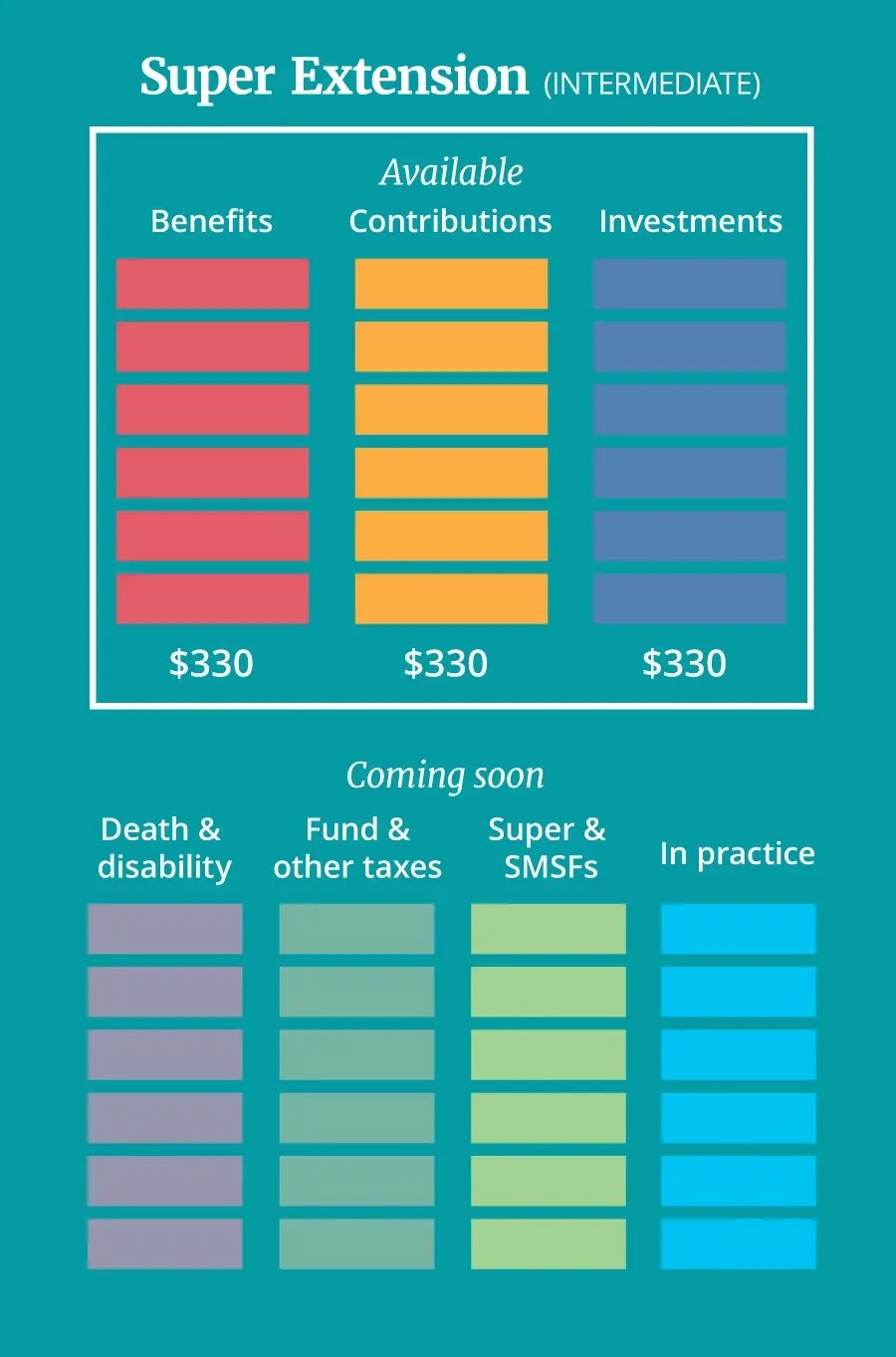
$330 per topic (incl GST)
Delivered by our award-winning industry experts, each topic area tackles the key complexities you may come across day to day in your practice.
The first three topics 'Contributions', 'Benefits' and 'Investments' are available now with 'Fund & other taxes' coming soon!
After completing this topic area, learners will be able to:
-
recognise the various transactions which are contributions to super (both the common and not so common) and why they are regarded as contributions;
-
explain the various ways in which contributions are made (to both SMSFs and non-SMSFs);
-
identify when various different types of contributions are made and why that date is important; and
-
apply their learnings to everyday client scenarios.
After completing this topic area, learners will be able to:
-
explain when different types of contributions can and cannot be accepted;
-
identify the action to be taken if an SMSF trustee accepts a contribution when the member wasn’t eligible; and
-
apply their learnings to everyday client scenarios.
After completing this topic area, learners will be able to:
-
recognise the different contribution caps and how the amounts are determined;
-
determine the particular cap to which a contribution is counted and why;
-
identify who can use the catchup contribution rules and the categories of clients for whom it might be useful;
-
identify who can use the bring forward rules and how the amounts are determined;
-
understand what happens if a member exceeds their cap and identify steps which could be put in place to stop an excess happening;
-
calculate an individual’s total super balance; and
-
apply their learnings to everyday client scenarios.
-
identify if an employer can claim a tax deduction for contributions for particular individuals;
-
distinguish when the “engagement test” needs to be met;
-
explain how an SMSF’s status on Super Fund Lookup impacts whether an employer can make contributions to the fund;
-
identify reportable super contributions and their impact on an individual; and
-
apply their learnings to everyday client scenarios.
-
recognise if and when an individual is able to claim a tax deduction for a contribution;
-
analyse a client’s circumstances and determine (if relevant) whether or not they will need to meet the work test or qualify for a work test exemption;
-
explain the notice requirements for personal deductible contributions; and
-
apply their learnings to everyday client scenarios.
After completing this topic area, learners will be able to:
-
explain why the Government offers tax concessions to encourage low income earners to save for their retirement via super;
-
explain the Low Income Super Tax Offset and determine who is entitled to it;
-
explain what is required to qualify for a Government co-contribution and how it is calculated;
-
explain the tax offset which is available for individuals who make contributions for their spouse; and
-
apply their learnings to everyday client scenarios.
After completing this topic area, learners will be able to:
-
understand the difference between preserved, restricted and unrestricted benefits;
-
calculate a member’s preserved, restricted and unrestricted balance;
-
identify whether a member satisfies a condition of release and whether there are any cashing restrictions; and
-
help clients wanting to access their super benefits identify their options.
After completing this topic area, learners will be able to:
-
explain the rules applicable for the two main types of super pensions (retirement phase account-based pensions and transition to retirement pensions);
-
calculate minimum and maximum pension payments under a range of scenarios;
-
identify any special reporting requirements for SMSFs providing pensions; and
-
apply this knowledge for the benefit of clients.
After completing this topic area, learners will be able to:
-
explain what a super lump sum means and how it can be paid;
-
understand the difference between a super lump sum arising from the full or partial commutation of a pension and other lump sums;
-
understand the documentation required to formalise a super lump sum from an SMSF; and
-
apply this knowledge for the benefit of your clients.
-
explain what the transfer balance cap is and its role in the super system;
-
calculate an individual’s transfer balance cap and the amount of their cap used to date by understanding the transactions that impact a member’s transfer balance account;
-
explain the consequences of exceeding the transfer balance cap and the ways in which this can be resolved; and
-
apply this knowledge for the benefit of clients.
-
explain key super benefit tax concepts such as the proportioning rule and how it applies to both income streams and lump sums;
-
explain how benefits are taxed under a variety of circumstances; and
-
apply these rules to your clients’ super benefits.
After completing this topic area, learners will be able to:
-
explain how various super interests are taken into account for the purposes of the age pension and the Commonwealth Seniors Health Card;
-
understand the importance of 1 January 2015 as a key date for income streams; and
-
apply this knowledge for the benefit of your clients.
After completing this topic area, learners will be able to:
- evaluate whether a particular super fund transaction or investment will satisfy the sole purpose test;
- explain the trustee covenants and the consequences if they aren’t met;
- demonstrate how to apply the keeping fund assets separate rules;
- explain broadly when loans are permitted/not permitted;
- differentiate a loan from an inadvertent mistake or illegal early release;
- explain the concept “commercial terms”; and
- use this knowledge to help clients evaluate the legality of an investment.
After completing this topic area, learners will be able to:
- identify the key requirements of an ATO compliant investment strategy;
- explain to SMSF trustees how to construct an ATO compliant investment strategy;
- evaluate the investment strategies of clients to determine if they will meet the ATO’s requirements; and
- apply their learnings to everyday client scenarios.
After completing this topic area, learners will be able to:
- identify whether an investment of an SMSF is an in-house asset;
- explain how the allowed in-house limit is calculated;
- explain what happens if the allowed in-house limit is exceeded; and
- apply their learnings to everyday client scenarios.
- explain the key terms “Part 8 associate” and “related party”;
- identify the various Part 8 associates of an SMSF member; and
- apply their learnings to everyday client scenarios.
- identify which assets cannot be acquired from a related party; and
- assist clients in identifying potential breaches of these rules.
After completing this topic area, learners will be able to:
- differentiate between real property and non-real property;
- describe the wholly and exclusively test;
- evaluate whether a particular property qualifies as business real property and when it needs to meet that definition; and
- apply their learnings to everyday client scenarios.
- recognise the transactions which are a borrowing and why they are treated that way;
- identify whether a particular borrowing by an SMSF is allowed;
- explain the key features of a limited recourse borrowing arrangement or LRBA;
- identify if an asset is a “single acquirable asset”;
- explain the restrictions which apply whilst an LRBA is in place; and
- apply their learnings to everyday client scenarios.
Not sure this course is right for you?
Take our 60 second Education Quiz. Simply answer a few quick questions to see our recommendations on the most suitable Education options we offer based on your role, experience and learning goals. See an overview here.
Become an SMSF expert with Super Specialist
Enrich your technical knowledge when you’re wanting to specialise in super & SMSFs. You control your learning by targeting one topic at a time. After you've successfully completed a Super Extension topic you can then enrol in the Super Specialist topic to advance your learning ever further!
Heffron was named SMSF Adviser Educator of the Year in 2022 and 2023.
We’re a trusted leader in superannuation services with a 25-year legacy. Our team advise and regularly consult to regulators, government and the media.

You may also be interested in...
Super Foundations course
Super Foundations provides the big picture overview of superannuation and SMSFs. It's designed to give you the essentials, including the industry context and language you need to know.
Super Toolkit
Manage clients with efficiency and precision while minimising compliance risk with our guided tools for super documentation creation.
Super Companion
The source of truth on super and SMSFs, and the only resource you’ll ever need. Super Companion gives you a practical and comprehensive technical online resource for SMSF professionals.